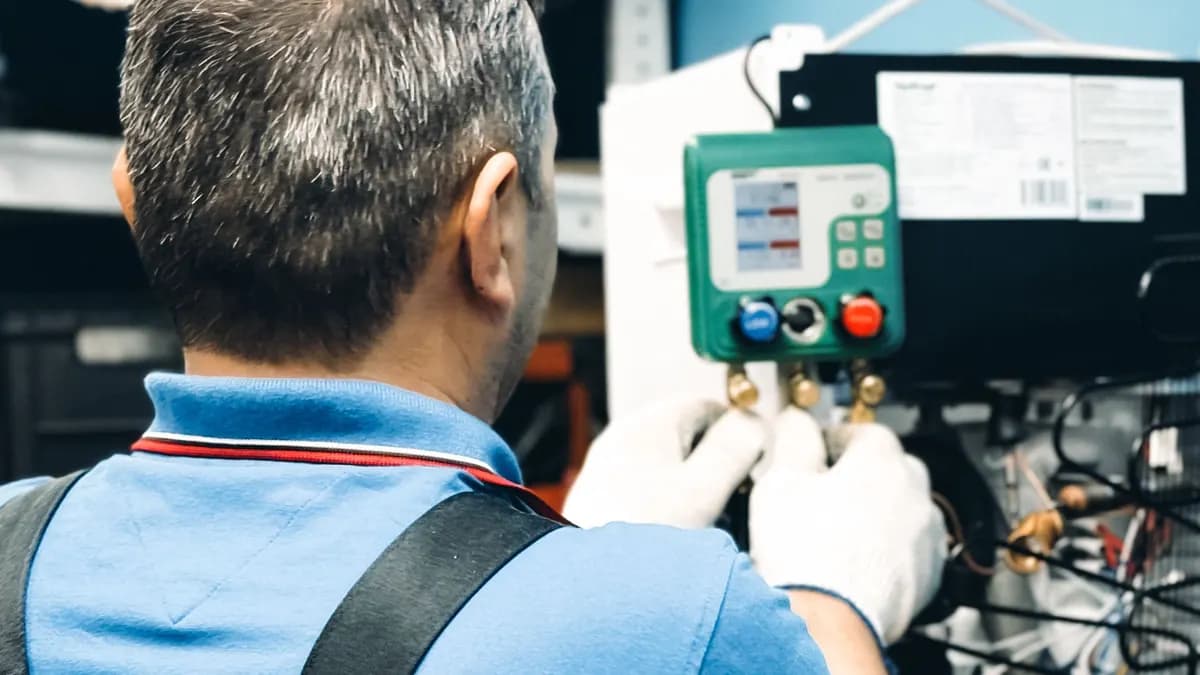
What the dispute is about
Maintenance costs appear in almost every German commercial lease: the annual inspection of the ventilation system, sprinkler servicing, the lift contract. What is disputed is not whether such costs may be passed on, but how the clause must be worded. Specifically: does it need a cost cap in monetary terms so the tenant can foresee the exposure they are taking on?
Four appellate decisions from the past eighteen months answer that question in opposite ways. The Federal Court of Justice has not yet ruled; leave to appeal has been granted. 7
Servicing, upkeep, repair
The distinction carries the whole dispute, so first things first:
Wartung (servicing) means scheduled, recurring, preventive measures. A ventilation system is inspected annually, filters are replaced, functionality is documented. These costs arise regularly and their scale can be estimated.
Instandsetzung (repair) remedies defects and damage that have already occurred. Nobody knows in advance when an installation will fail or what the repair will cost. 9
This boundary matters legally because maintaining the leased property is the landlord's responsibility under section 535 BGB. Whatever the tenant is to take over must be expressly stipulated in the contract. And section 1(2) BetrKV expressly excludes upkeep and repair costs from operating costs. 2,3
What the Federal Court of Justice has already decided
For the upkeep of shared areas and installations, a clear limit has applied since 2012. The court put it this way: transferring that burden is „nur dann wirksam, wenn sie in einem zumutbaren, durch eine Kostenbegrenzung beschriebenen Rahmen erfolgt" (only valid if it takes place within a reasonable framework defined by a cost limit). Without a cap, the clause unreasonably disadvantages the tenant and is invalid under section 307 BGB. 1,4 The court confirmed this line in 2014. 5
The decisive point for today's debate: in that decision, the servicing of technical installations was governed together with upkeep in a single clause. The court struck the clause as a whole and therefore did not have to answer whether a pure servicing clause requires a cap on its own. That is precisely the gap the appellate courts are now filling in different ways. 4,7
Four judgments, two answers
| Court | Decision | Cost cap required? |
|---|---|---|
| OLG Rostock | 06.03.2025 – 3 U 68/23 | yes |
| OLG Rostock | 08.10.2025 – 3 U 109/22 | yes |
| OLG München | 12.02.2026 – 14 U 1880/25e | yes |
| OLG Karlsruhe | 27.03.2026 – 4 U 102/24 | no |
Rostock and Munich see no material difference from upkeep. Maintenance costs, they hold, are not reliably calculable for the tenant either, particularly for complex shared installations. Uncapped allocation therefore places an unreasonable burden on them. The Munich court additionally classifies servicing as part of the maintenance obligation and applies the Federal Court of Justice principles directly. 6,8
Karlsruhe disagrees: servicing is a different matter. Because the measures recur predictably and specifically do not serve to remedy damage, the costs are foreseeable. They are therefore ordinary operating costs, and the law requires no cap for those. 9
When the clause mixes servicing and upkeep
Many contracts cover both in a single sentence: "servicing, upkeep and repair of the technical installations". For this situation the Rostock court applied the so-called blue-pencil test. If the word "servicing" is deleted, what remains is a provision that is comprehensible in itself and retains its own scope of application. The clause does not fall away entirely; it continues to apply without the servicing element. 6
In practice this means that whether a clause is wholly or only partly invalid turns on its sentence structure. Two contracts with the same commercial substance can end differently because one separates what the other combines.
What real contracts contain
In the commercial leases we analyse at Boomerent, maintenance clauses without a monetary limit are not a marginal phenomenon. A typical formulation assigns the servicing of technical installations to the tenant in blanket terms, without naming the individual installations and without setting a ceiling. Just as frequently, servicing appears in the same breath as upkeep and repair, which is exactly the constellation the courts are arguing about.
Where servicing appears in the contract is also striking. Often it is not a separate item but sits under "sonstige Betriebskosten", catch-all item no. 17 of the BetrKV schedule. Independently of the cost-cap question, the rule there is that such costs can only be passed on if the individual cost types are specifically named. A blanket formulation is not enough. More on this in the overview of allocable operating costs in commercial leases. 3
How to place your own clause
Four questions help with an initial assessment:
- Is servicing mentioned in the contract at all? Without an express agreement, the maintenance obligation stays with the landlord (section 535 BGB). What the contract does not name cannot be passed on. 2
- Are the installations listed individually? A clause that merely says "servicing of technical installations" is a different matter from a list naming ventilation, lift, fire alarm system and sprinklers.
- Is there a cost cap? A percentage of the annual rent or an absolute amount. If neither is present, the dispute described here concerns you directly.
- Does servicing stand alone or together with upkeep? That determines which part of the clause is even at issue in a dispute. 6
The same clause, two outcomes
Until the Federal Court of Justice rules, an identically worded maintenance clause can be valid before one appellate court and invalid before another. The place of jurisdiction therefore also matters when assessing a specific case.
What happens next
Leave to appeal to the Federal Court of Justice has been granted. A definitive ruling is therefore in sight, but its outcome is open. 7
For tenants with running contracts, the sensible first step is to know their own contract precisely: whether a maintenance clause exists, which installations it covers, whether it sets a limit, and how it is linked linguistically to upkeep. Those four points determine whether the forthcoming ruling will matter to you at all.
Whether any claims follow in a specific case depends on the contract wording, the place of jurisdiction, the accounting period and limitation periods, and belongs in the hands of a lawyer.
This article is general information and does not replace individual legal advice.
Frequently asked questions
Does a maintenance clause in a German commercial lease need a cost cap?
This is unresolved. The Rostock and Munich Higher Regional Courts consider a cap necessary; the Karlsruhe Higher Regional Court does not. Appeal to the Federal Court of Justice has been allowed and a ruling is pending. Until then, the assessment also depends on which court would have jurisdiction.6,7
What is the difference between Wartung (servicing) and Instandsetzung (repair)?
Wartung means scheduled, recurring, preventive measures on technical installations, such as the annual inspection of a ventilation system. Instandsetzung remedies defects and damage that have already occurred. The distinction determines whether costs can be passed on, because under Federal Court of Justice case law repair costs require a cap.4,9
Has the Federal Court of Justice not already decided this?
Not for servicing on its own. In the leading decision XII ZR 112/10 servicing was combined with upkeep in the same clause, so the court did not have to rule on a standalone servicing clause. That is precisely the gap the appellate courts are now filling in different ways.4,7
What does this mean for my current service-charge statement?
As long as the Federal Court of Justice has not ruled, the legal position remains open. Anyone finding an uncapped maintenance item in their statement should know the underlying contractual clause and have the case assessed by a lawyer. This article does not replace that.7
Sources
- 1Section 307 BGB – Review of subject matter (standard business terms) — Federal Ministry of Justice (gesetze-im-internet.de), accessed 2026-08-03
- 2Section 535 BGB – Content and primary obligations of the lease — Federal Ministry of Justice (gesetze-im-internet.de), accessed 2026-08-03
- 3Section 1 BetrKV – Operating costs — Federal Ministry of Justice (gesetze-im-internet.de), accessed 2026-08-03
- 4Federal Court of Justice, judgment of 26 September 2012 – upkeep of shared areas only valid with a cost limit — lexetius.com (full text) (BGH XII ZR 112/10 (26.09.2012)), accessed 2026-08-03
- 5Standard-form allocation of upkeep costs for shared areas without a cost cap is invalid — Vermieterverein e.V. (BGH XII ZR 56/11 (10.09.2014)), accessed 2026-08-03
- 6Rostock Higher Regional Court, judgment of 8 October 2025 – “No cost cap, no maintenance costs” — dejure.org (OLG Rostock 3 U 109/22 (08.10.2025)), accessed 2026-08-03
- 7Allocation of maintenance costs in commercial leases: conflicting appellate case law, Federal Court of Justice ruling still pending — W·I·R Breiholdt Rechtsanwälte (OLG Rostock 3 U 68/23 · OLG München 14 U 1880/25e · OLG Karlsruhe 4 U 102/24), accessed 2026-08-03
- 8Munich Higher Regional Court, final judgment of 12 February 2026 – 14 U 1880/25 e — Bavarian State Chancellery (gesetze-bayern.de) (OLG München 14 U 1880/25e (12.02.2026)), accessed 2026-08-03
- 9Maintenance costs in commercial leases: is a cost cap required? — BRL Rechtsanwälte (OLG Karlsruhe 4 U 102/24 (27.03.2026)), accessed 2026-08-03

Co-founder, Boomerent
Co-founder of Boomerent. Stephan spent 16 years leading national and international commercial real estate on the landlord side — in leadership roles at Hines, Cushman & Wakefield, and ECE, including as Director of Hines Asset Services (€6.5 bn AUM) and Head of Center Management for the Sony Center Berlin. He knows first-hand how leases and service-charge statements are built — and brings that knowledge to the tenant's side with Boomerent. Brings the real-estate expertise the analysis of commercial leases and service-charge statements is built on.